

- Courier service to home from 4,99 € from 2-3 tööpäeva
- Pick up from the store from 15.11.2026
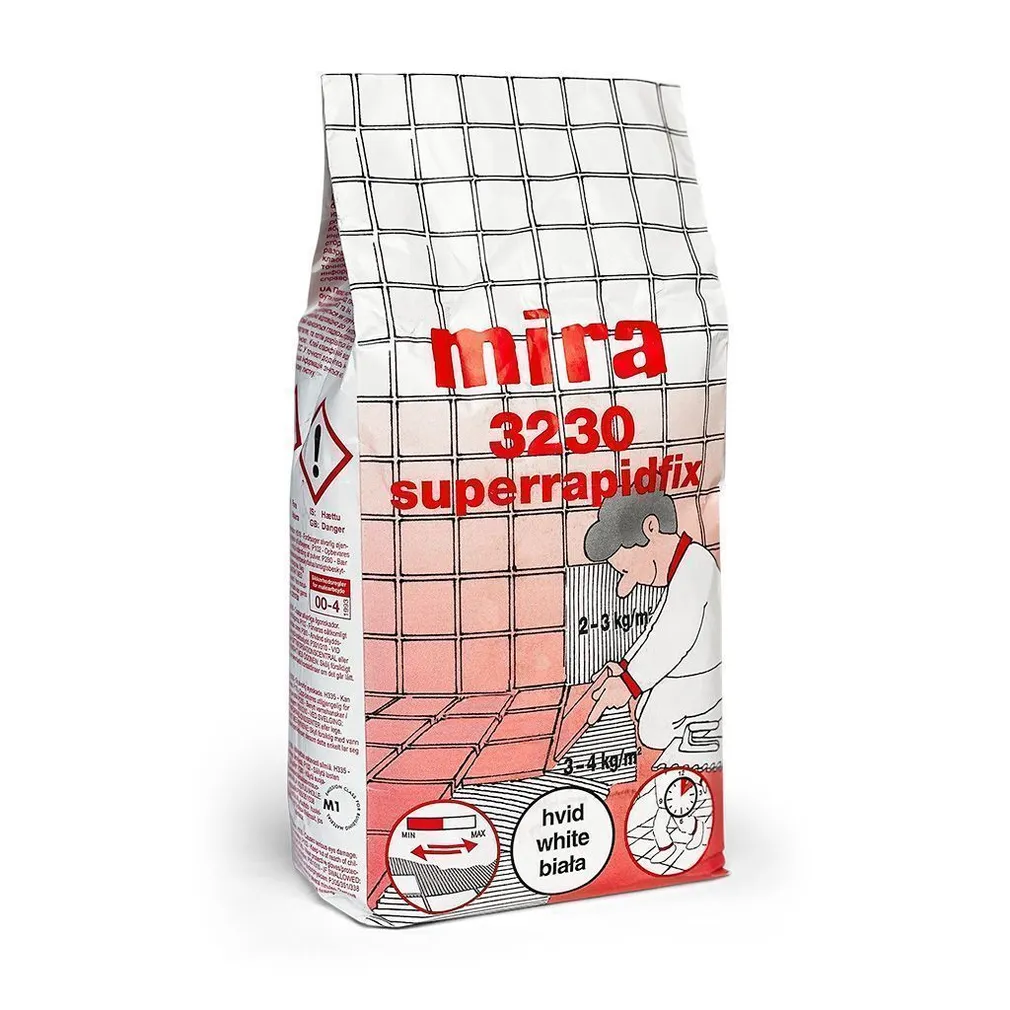
MIRA 3230 SUPERRAPIDFIX TILE ADHESIVE, 5 KG
SKU: 007281
19.32 € /pcs
13.52 €
The special prices of the online store may differ from the prices of the regular store
Discount 5.80 € (30%)
E-shop campaign price for a logged-in customer
A white, cement-based, polymer-reinforced, fast-setting tile adhesive for walls and floors, for indoor and outdoor use, in damp and dry areas, on substrates subject to moderate deformation.
- Courier service to home from 4,99 € from 2-3 tööpäeva
- Pick up from the store from 15.11.2026
Product Description: White, cement-based, frost-resistant, waterproof, rapid-setting, polymer-reinforced dry mix.Applications: For installing all types of ceramic tiles, clinker tiles, and natural stone on walls and floors, indoors and outdoors, in dry and damp areas. Particularly suitable for installing on heated floors, as well as for glass mosaics, thin semi-transparent tiles, marble, and similar materials.
Substrate Type Floors and walls with moderate deformation, such as plastered
masonry, stone walls, gypsum boards, gypsum plaster, concrete elements, and lightweight concrete elements with moderate volume expansion.
Substrate Preparation
The substrate must be load-bearing, stable, free of cracks, and clean of dust, grease, and cement slurry. The surface should be dry enough for the mira 4180 primer to be absorbed.
When installing on old tiles or painted surfaces, ensure that the tiles and paint are firmly adhered. Clean the surface using mira 7110 base cleaner.
Prime absorbent surfaces with 4180 primer, and make damp rooms watertight in accordance with ETAG 022 regulations and Mira’s instructions. For best results, use a mixer. The powder, water, and substrate must be within the recommended working temperature range. The tile mixture must be used within 30 minutes after mixing. It is not recommended to apply the mixture to large surfaces
unless the tiles can be laid before a skin forms. Spread 3230 SuperRapidFix onto the surface and smooth it out with the straight edge of a trowel, then comb it through with the notched edge. Select the trowel according to the tile type. Press the tiles into the wet mixture. Ensure that the back of the tile is completely covered with the mixture. For complex structures such as porches, facades, swimming pools, etc., the mixture must be applied to both the substrate and the tile to achieve 100% coverage. Surfaces larger than 36 m² or with sides longer than 8 m are typically divided into separate work sections throughout the entire structure. Depending on the tiles’ absorbency and the room temperature, the surface is ready for further processing in about 1–2 hours.
| General | |
|---|---|
| Brand | Mira |
| Product code | 007281 |
| Package dimensions | |
|---|---|
| Product weight, kg | 5 |
| Package height, cm | 24 |
| Package depth, cm | 9 |
| Package width, cm | 14 |
| Weight, kg | 5 |
| Product information | |
|---|---|
| Application | Universal |
| Package size unit | Kg |
Bauhof Transport
Courier service to home from 4,99 € from 2-3 tööpäeva
Delivery by courier. A Bauhof courier will deliver the goods to the doorstep at the destination. Carriage of the goods to the door or to the apartment is not included. Once the ordered products have been delivered to the courier company, the courier company will contact you in advance to specify the delivery time.
Check out more detailed terms here I'll follow myself
Pick up from the store from 15.11.2026
I'll come to the Bauhof store myself to order. Estimated time of delivery from the store is indicated on the product card. We will send you a notification when the goods arrive at the store.
Check out more detailed terms here