

- Delivery is not possible
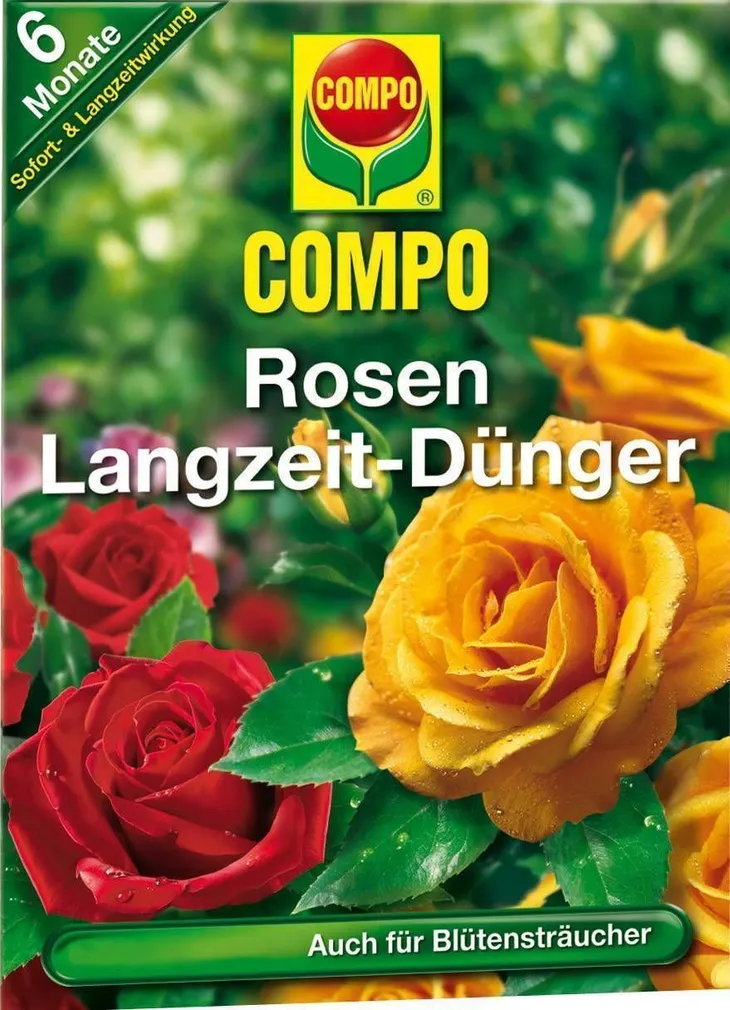
FERTILIZER FOR ROSES, LONG-LASTING COMPO, 1 KG
SKU: 437685
We apologize, but we inform you that the desired product is currently temporarily out of stock due to high demand. However, we offer excellent alternatives from the same product category , which can bring you just as much joy!
But your shopping pleasure doesn't have to end here - you can continue your research by returning to the homepage or use our powerful search function to discover even more great options. Happy shopping!
• Suitable for roses and flowering shrubs (lilacs, mock orange, forsythia, etc.)
• Resistant to diseases and pests, ensuring beautiful and long-lasting
blooms• A single application of fertilizer is sufficient for the entire blooming
season
- Delivery is not possible
Compo’s long-acting granular rose fertilizer produces beautiful, long-lasting blooms. A single application is sufficient for the entire blooming season. Optimal nutrient supply thanks to its initial and long-lasting effect (6 months). No over- or under-fertilization: dosage adjusted to need based on moisture and temperature. All essential macro- and micronutrients work together to ensure strong blooms and healthy growth. Resistance to diseases and pests is enhanced. Compo’s long-acting rose fertilizer is tailored to the needs of roses and flowering shrubs (lilacs, mock orange, forsythia, etc.).
Directions for Use:
•Roses – new plantings in early spring: 60 g/m² in May/June; new plantings in fall: 80 g/m² in April/May of the following year. Mix the fertilizer granules thoroughly with the soil before planting.
•Roses (existing plants): 120 g/m² in April/May; flowering shrubs: 80 g/m² in April/May.
•Hanging and climbing plants: 60 g/m² in April/May. Spread the fertilizer and mix it with the soil, or mix it with the soil in the planting hole. 1 tablespoon of fertilizer = approx. 25 g.
Important: Apply the fertilizer only to the soil. If the fertilizer comes into contact with flowers or leaves, remove it. After use, reseal the package to protect the fertilizer from moisture.
Nutrient content:
Nitrogen (N) 14%, of which 6.4% as nitrate (NO3) and 7.6% as ammonium (NH4), Phosphorus 4.3% (P₂O₅: 10%, of which 6.3% is water-soluble), Potassium 11.6% (K₂O: 14%, of which 14% is water-soluble), magnesium oxide (MgO) 2%, of which 1.6% is water-soluble; sulfur (S) 7%, of which 5.8% is water-soluble. Micronutrients: boron (B) 0.02%, copper (Cu) 0.028%, iron (Fe) 0.36%, manganese (Mn) 0.033%, molybdenum (Mo) 0.08%, zinc (Zn) 0.015%. Low in chloride.
| General | |
|---|---|
| Brand | Compo |
| Product height, cm | 22 |
| Product width, cm | 14 |
| Product depth, cm | 5 |
| Product code | 437685 |
| Package dimensions | |
|---|---|
| Product weight, kg | 1.09 |
| Package height, cm | 22 |
| Package depth, cm | 5 |
| Package width, cm | 14 |
| Weight, kg | 1.09 |
| Product information | |
|---|---|
| Manufacturing country | Germany |
| Capacity | 1 |
| Use purpose | Väetamine |
Delivery is not possible