
- Pick up from the store from 19.11.2026
- Home delivery from 16,90 € from 2-3 tööpäeva
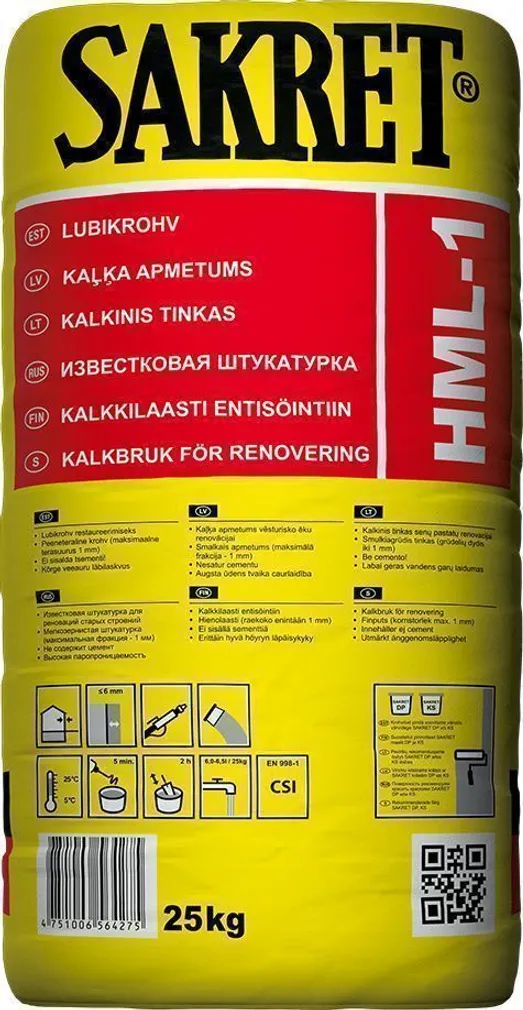
LIME PLASTER SAKRET HML1 WITH 1 MM FIBERS, 25 KG
SKU: 517409
11.99 € /pcs
8.39 €
The special prices of the online store may differ from the prices of the regular store
Discount 3.60 € (30%)
E-shop campaign price for a logged-in customer
• Traditsiooniline kustutatud lubjaga lubikrohv, ei sisalda tsementi.
• Fassaadide ja siseruumide krohvimiseks.
• Tera suurus kuni 1 mm. Krohviklass CS I.
• 14-päevane tagastusõigus.
• Fassaadide ja siseruumide krohvimiseks.
• Tera suurus kuni 1 mm. Krohviklass CS I.
• 14-päevane tagastusõigus.
- Pick up from the store from 19.11.2026
- Home delivery from 16,90 € from 2-3 tööpäeva
Sakret HML-1 traditional lime plaster for exterior and interior use.
• For walls and ceilings•
Suitable for weak and porous substrates•
Suitable for
plastering limestone or traditional and modern mineral materials• Suitable for
plastering mesh and plaster wool• Suitable for
plastering wooden surfaces• Suitable for
recoating old lime and lime-cement plasters•
For application with a plaster pump or by hand• Does not contain
cement• Suitable for
grouting limestone• Environmentally
friendly• Highly
elastic• Also available
with reinforcing fibers• High water vapor permeability•
White in
color Surface Preparation
The substrate must be sound, dry, stable, and free of cracks. Clean the surface of weak, loose, and flaking layers such as dirt, salts, dust, oil, or paint residues, etc. Roughen particularly dense and smooth surfaces beforehand. Prime the substrate with Sakret SILICATE, Sakret TGW, or lime wash. Moistening the substrate also improves adhesion. Cover areas not intended for plastering (metal surfaces, window frames, glass, etc.).
Application Procedure
: Mix the dry mix with cold water in a clean container until a uniform consistency is achieved; there must be no unmixed lumps in the plaster mortar. Let the mortar stand for about 3 minutes, then remix. Do not add water to a mixture that has begun to set! Apply the mixture to the substrate using a plastering pump, trowel, steel float, or steel trowel to a layer thickness of 3 to 12 mm. For layer thicknesses over 20 mm, use galvanized steel mesh in the mixture. Moisten the surfaces between plaster layers. Level the surface with a straightedge, putty knife, or plaster trowel. Plastered surfaces can be finished with a plastic, rubber, or stone trowel. It is recommended to re-moisten the plastered surface. The plastered surface can be finished after at least 24 hours. Painting can be done after at least 14 days. Plastered surfaces can be finished with Sakret facade paints KS, SKF, and DP or with interior finishing materials. The optimal substrate and ambient air temperatures during application are +10°C to +25°C; avoid temperatures higher than +30°C and sub-zero temperatures.
| General | |
|---|---|
| Brand | Sakret |
| Product code | 517409 |
| Package dimensions | |
|---|---|
| Product weight, kg | 25 |
| Package height, cm | 52 |
| Package depth, cm | 11 |
| Package width, cm | 32 |
| Weight, kg | 25 |
I'll follow myself
Pick up from the store from 19.11.2026
I'll come to the Bauhof store myself to order. Estimated time of delivery from the store is indicated on the product card. We will send you a notification when the goods arrive at the store.
Check out more detailed terms here Bauhof special transport
Home delivery from 16,90 € from 2-3 tööpäeva
Special transport is a convenient way to order large-scale materials. By entering the postal code in the shopping cart, we will find the exact cost of transport to your door. Charges for both goods and transport service at the same time. The exact delivery time of the goods is agreed in person by the Bauhof customer service.
Check out more detailed terms here