

- Delivery is not possible
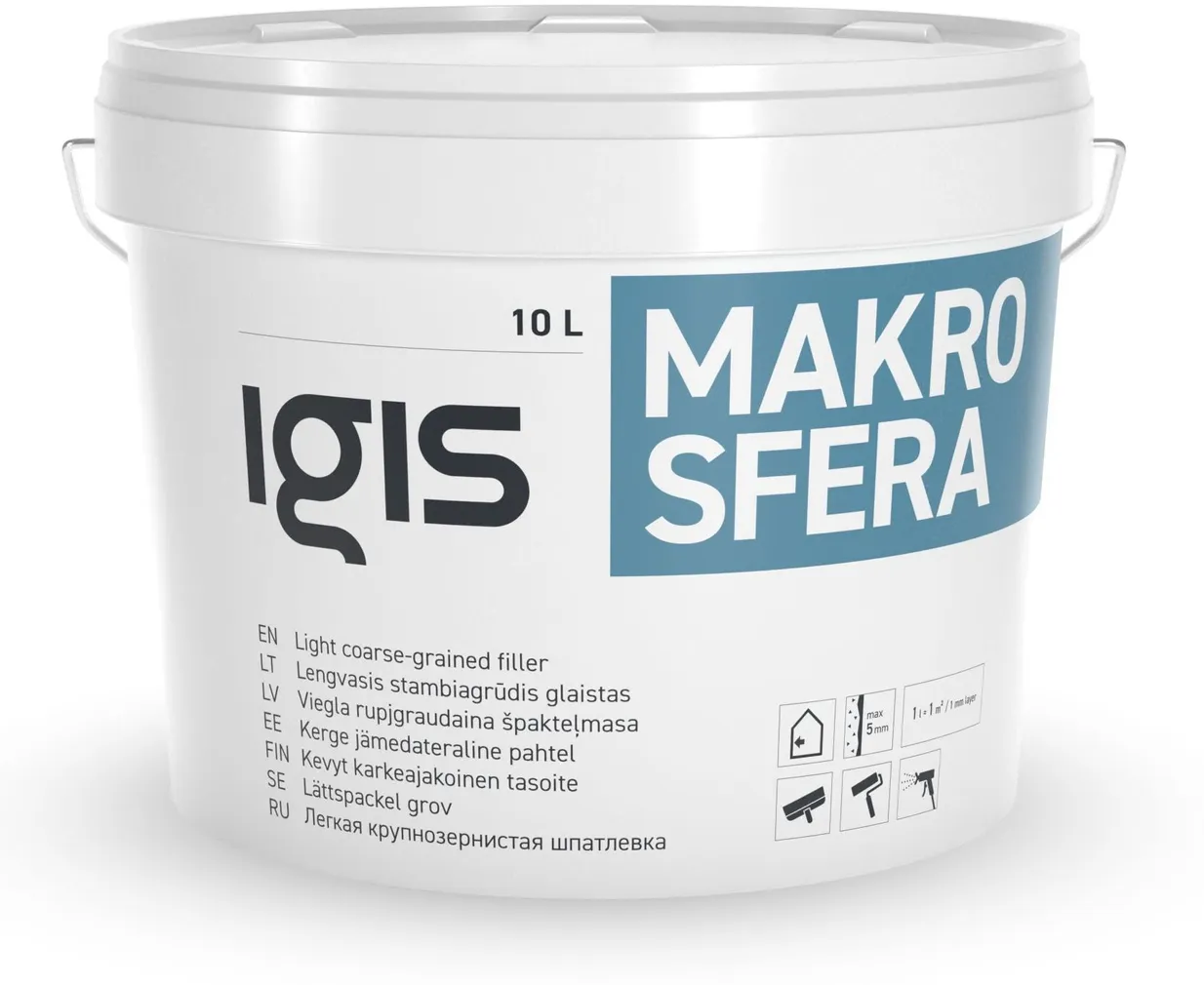
PAHTEL IGIS MAKROSFERA 10L COARSE-GRAINED
SKU: 690196
We apologize, but we inform you that the desired product is currently temporarily out of stock due to high demand. However, we offer excellent alternatives from the same product category , which can bring you just as much joy!
But your shopping pleasure doesn't have to end here - you can continue your research by returning to the homepage or use our powerful search function to discover even more great options. Happy shopping!
But your shopping pleasure doesn't have to end here - you can continue your research by returning to the homepage or use our powerful search function to discover even more great options. Happy shopping!
• Ready-to-use, lightweight, coarse-grained finishing putty for interior use.
• Easy to apply and level, with low water absorption and good vapor permeability; dries quickly.
• Package size: 10 liters.
• 14-day return policy.
• Easy to apply and level, with low water absorption and good vapor permeability; dries quickly.
• Package size: 10 liters.
• 14-day return policy.
- Delivery is not possible
Igis Makrosfera is a very lightweight, coarse-grained, lightly filled, polymer-based finishing putty for interior use. It is easy to apply and level, has low water absorption and good vapor permeability, and dries quickly. Package size: 10 liters.
Technical Specifications
Color: white
Maximum particle size: 0.35 mm
Coat thickness: 4–5 mm
Coverage: when applying a 1 mm layer, coverage is ~1 L/m²
Drying time: drying time depends on the substrate, layer thickness, temperature, relative humidity, etc. Drying time for a 1 mm layer (at +23°C and 50% relative humidity): can be sanded after 2–4 hours. A 1 mm layer dries completely after 24 hours and reaches its final strength after 28 days.
Application temperature: suitable air and surface temperatures are +8 to 25°C, with relative humidity of 35–80%. Avoid drafts, high temperatures, and low temperatures during application.
Application
: The putty is intended for leveling concrete, plaster, drywall, and other mineral surfaces prior to painting with water-based paints or hanging wallpaper. It adheres very well to substrate surfaces. It is flexible, sands very easily, and does not produce dust. Due to the putty’s low water absorption, surfaces do not need to be primed before painting. It allows for easy creation of textured surfaces. Improves the sound and thermal insulation of walls. Recommended for use as the first layer when leveling unevenness in the substrate.
Substrate Preparation
The surface to be filled must be dry, load-bearing, solid, even, and clean. It must not have any flaking layers. Old flaking paint must be removed from the surface; soft surfaces must be cleaned down to a solid substrate. To improve adhesion, previously painted smooth surfaces must be sanded and dust removed. Surfaces previously coated with chalk or lime must be thoroughly washed to remove all traces of previous coatings. Surfaces contaminated with mold or other microorganisms must be completely cleaned using suitable cleaning agents. Fill the joints in gypsum board with a reinforcing joint compound. Prime dense, low-water-absorbing mineral surfaces or waterproof concrete surfaces with a special primer. Porous surfaces that absorb water heavily or unevenly (lightweight concrete, silicate bricks, gypsum boards, etc.) should be treated with a suitable deep-penetrating primer.
Filling
The filler is supplied ready for use. It must not be mixed with other materials. Before use and during application, the putty must be thoroughly mixed until a uniform consistency is achieved. When applying the putty, the air temperature must be above +8…10°C, with relative humidity between 35–80%. The putty can be applied to surfaces manually with a putty knife or mechanically. For mechanical application, it is recommended to use an airless high-pressure sprayer. The first coat must be completely dry before applying the second coat. The maximum thickness of a single layer of putty is 4–5 mm. If MAKROSFERA, a light-weight, coarse-grained putty, is used for the first layer, it is recommended to use MIKROSFERA, a light-weight, fine-grained putty, for the final layer. Sand the dried fine-grained putty surface with #200–240 sandpaper until smooth. Carefully remove all sanding dust. Once the putty is completely dry, the surface can be painted with water-based decorative and finishing paints. Wash tools clean with water.
Storage
1 year from the date of manufacture indicated on the packaging. Store in the original, hermetically sealed container at a temperature of +5…30°C; protect from freezing, intense heat, and direct sunlight.
Safety Precautions
Keep out of reach of children. Avoid release into the environment. Wear protective gloves, protective clothing, safety goggles, and a respirator. IF ON SKIN: Wash thoroughly with plenty of water and soap. If skin irritation or a rash occurs: seek medical attention. IF IN EYES: Rinse cautiously with water for several minutes. Remove contact lenses, if present and easy to do. Rinse again. If eye irritation persists: seek medical attention. Contains 1,2-benzisothiazol-3(2H)-one. May cause an allergic reaction. Keep away from cold.
Waste Disposal
: Take empty, dry packaging to a packaging waste collection point for recycling; place dry product residues in a household waste container, and hand over liquid residues to a waste management company licensed to handle them. Information on waste management companies is available from your local government or the Environmental Board.
| General | |
|---|---|
| Brand | Igis |
| Product code | 690196 |
| Package dimensions | |
|---|---|
| Product weight, kg | 10 |
| Package height, cm | 22.5 |
| Package depth, cm | 29.5 |
| Package width, cm | 32 |
| Weight, kg | 10.46 |
| Product information | |
|---|---|
| Application | In indoor conditions |
| Drying time, h | 1 mm kiht kuivab täielikult 24 tunni möödudes, lõpliku tugevuse saavutab 28 ööpäeva pärast. |
| Operating temperature, °C | Sobiv õhu- ja pinnatemperatuur on +8 kuni 25°С |
| Color tone | valge |
| Package size unit | L |
| Package size | 10 |
Delivery is not possible